
August 4, 2026 · 6 min read
What a cyc wall actually buys you
A cyc wall is not a green rectangle. It is the absence of a corner — and that absence is the whole point.
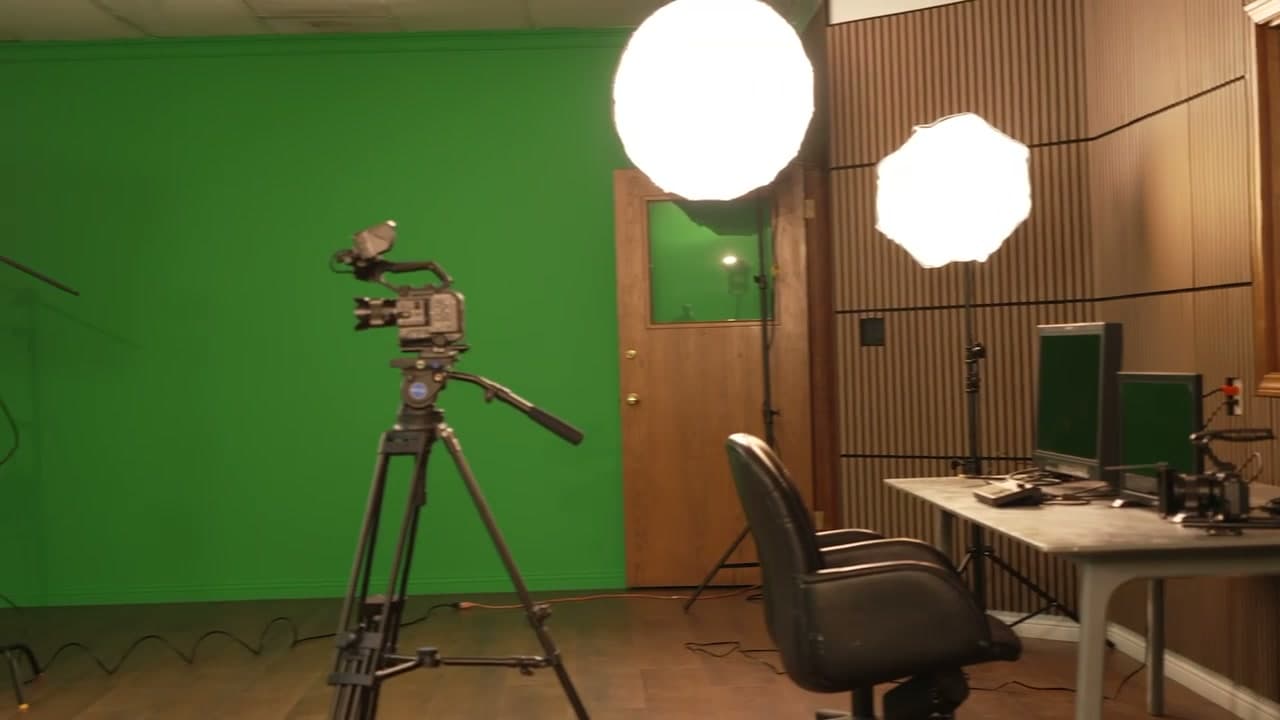
A cyc wall is not a green rectangle. It is the absence of a corner.
Where the wall meets the floor, there is no seam — the surface curves through the join and keeps going. Light falls across it without breaking. There is nothing for a shadow to catch on, and nothing for a key to announce.
That single property is what you are paying for when you book a cyc stage rather than a room with a painted wall, and it is worth understanding before you decide which one your shoot actually needs.
Why the corner matters
Shoot a subject against a flat painted wall and the room tells on you. The baseboard draws a line. The corner throws a hard vertical. However evenly you light it, an edit will find those seams and the eye will read room rather than space.
The problem is not that the seam is ugly. The problem is that it carries information. A horizontal line at floor level tells the viewer exactly how far away the wall is, and once they know that, the background has a location. You cannot composite a horizon into a space the audience has already measured.
Remove the corner and the background stops being a surface. It becomes a field. That is what you are renting.
What a cove actually is
The curve is called a cove, and its radius is the whole trick. Too tight and it still reads as a join under a hard key. Wide enough, and a soft source raked across it produces a fall-off so gradual that no single frame contains an edge.
The construction matters more than the paint. A cove built properly is continuous plaster or molded panel — one surface, no joint, sanded flat, then painted. A cove faked with a curved sheet screwed over an existing corner will photograph as a curve with two lines at either end of it, which is worse than an honest corner because now you have three edges instead of one.
Paint is the part people fixate on and the part that matters least, provided it is matte and provided it is even. A high-quality chroma paint that has been touched up in patches will key worse than a plain, uniformly rolled surface, because the patches differ in sheen and sheen is directional.
What it does not fix
A cyc wall will not save a bad key. It will not rescue a subject standing two feet from the paint, wearing green, lit from the front. The wall gives you a clean field to work against; the distance, the separation, and the backlight are still yours to get right.
The most common mistake we see is treating the wall as the solution rather than the starting condition. Pull your subject away from it. Light the wall separately. Give the grade something to work with. We have written the practical version of that elsewhere — lighting for a clean key covers the distances, the ratios, and the check you should run before you wrap.
How much wall you actually need
Width is decided by your lens and your subject's distance from the wall, not by the size of the subject. That catches people out.
Pull a subject ten feet off the wall for separation, then frame them on a longer lens for the compression you wanted, and you have narrowed your angle of view but pushed the camera back. The wall now has to cover the frame from further away. It is entirely possible to have a subject who fits comfortably and a background that runs out at the edges.
Work it the other way around. Decide the shot — focal length, subject size in frame — then measure how much background that shot sees at the distance you need for a clean key. Bring that number when you book a shooting stage, not the subject's height.
The floor is part of the answer too. A cove only helps if the shot includes the join, and if you are framing above the waist on a long lens you may never see it. Some shoots that think they need a cyc need a flat wall and more space in front of it.
When you do not need one
A cyc is the right room when the background has to disappear, when the subject moves through the frame, or when the shot includes the floor. Product on a sweep, a dancer crossing, a full-body composite: all cyc work.
It is the wrong room, or at least an expensive one, when the background is supposed to be somewhere. If the script says office, an office reads better than an office composited onto a stage — and it usually costs less. If you are shooting a talking head that never leaves the shoulders-up frame, a well-lit flat wall in a quiet room will do the job and leave you budget for a second day.
Choosing the stage when you did not need it is not a disaster. It is just a line item that bought you nothing.
Green or blue
Green reads brighter and needs less light, which is why it is the default. But green spills, and it spills onto anything that has green in it already — foliage, certain skin tones under warm key, half the costume department's wardrobe.
Blue needs more light and grades differently, but it stays out of the way of things green cannot help interfering with. If the shot involves plants, or a lot of warm skin, or a costume you cannot change, the blue stage is the cheaper decision even though it costs more in lamps.
There is a second consideration that rarely gets raised until it is too late: what is in the frame behind the camera. Spill is not only what the wall throws onto the subject. A green wall lighting a white ceiling lights everything under that ceiling green, including the monitor you are judging the key on. Blue is no better in principle, but it is a color people notice, which means somebody usually catches it.
Neither is better. They fail differently, and knowing which failure you can afford is the actual skill.
The short version
Book a cyc when the background needs to stop existing. Bring the framing, not the subject, to work out how much wall you need. Give yourself distance before you give yourself fixtures. And pick the color by what is in your frame, not by what is conventional.
If you are still deciding which room fits the shoot, the half day, full day, or week question is worth settling at the same time — the two decisions constrain each other more than people expect.
Written by Seven Film Studios · craft, stages